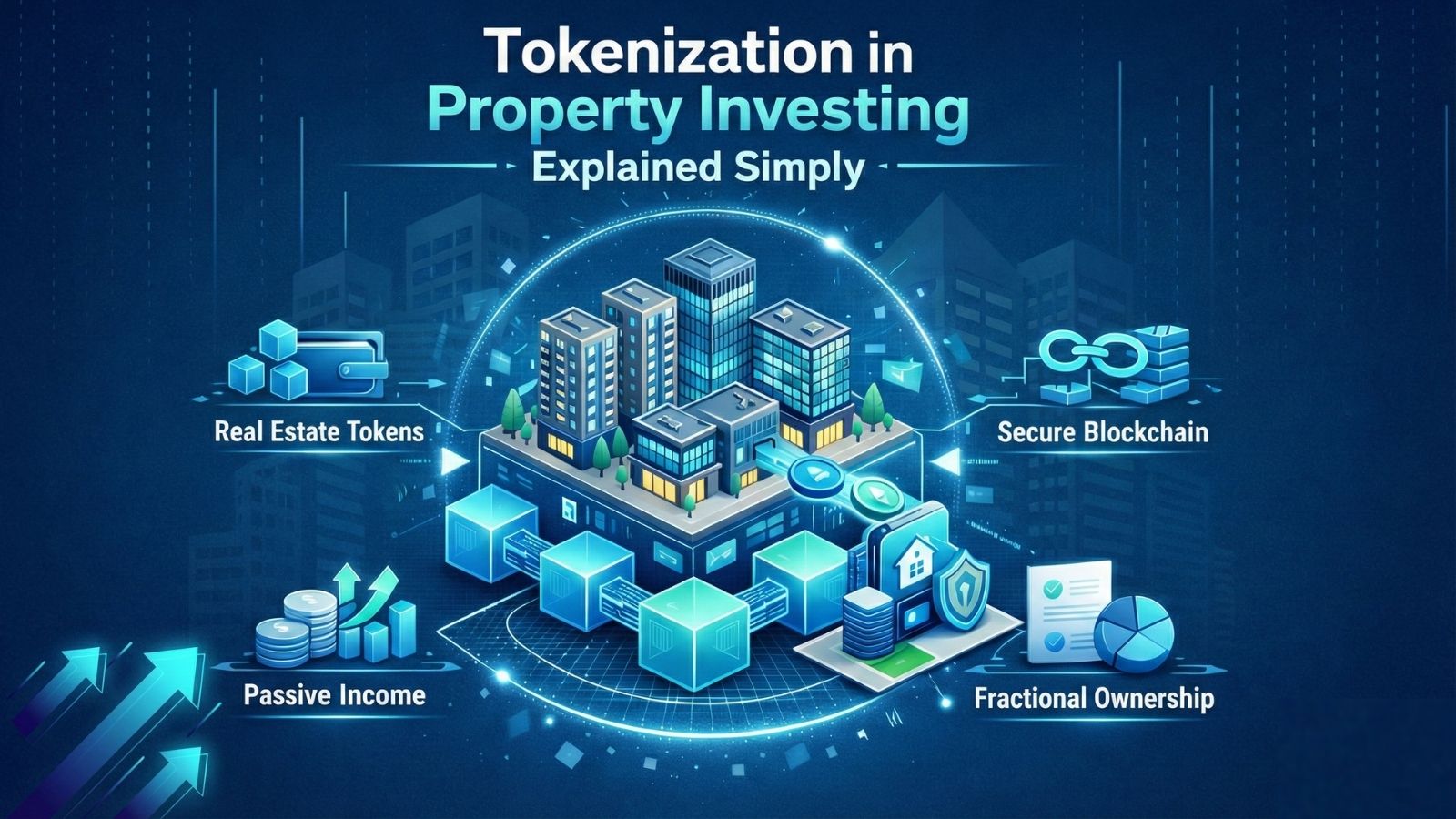
While property has always been sought after as a solid long-term asset, it is also famously illiquid, paperwork-heavy, and not accessible to all. This is where tokenization in property investing can be advantageous, as it attempts to address those agonizing points. This is achieved by turning property ownership, or the associated rights, into smaller digital units, making them easier to purchase, hold, and transfer.
Investors must not think that this is “crypto property” in the meme-coin sense. Rather is a compliant setup in which the blockchain element is predominantly used as a method of secure record-keeping and automation. The investors are protected by the legal structure that underpins the whole system, and the regulator rules above it. This distinction is more important in 2026 than ever before, especially as Saudi Arabia formalizes real estate tokenization infrastructure and standards.
Tokenization in Property Investing Explained for Beginners
Tokenization in property investing means splitting the economic value, and sometimes certain ownership rights, of a property into many small digital tokens. This is usually done through a special purpose vehicle* (SPV), which legally owns the property and allows investors to hold fractional exposure to the investment through those tokens.
We could picture this in the following way:
- The underlying real-world asset is the property
- The legal structure, often an SPV, holds the asset and defines the investor’s rights.
- Fractional interests or tokens are recorded and managed on a blockchain-enabled system to ensure accuracy and transparency.
- Finally, the use of smart-contract style automation can help speed up processes, track ownership, distribute income, while keeping an audit trail. This does not replace property law or investor regulation. The point of smart contracts is to streamline processes.
You can read more about smart contracts in our blog “Smart Contracts in Property Deals Explained.”
Tokenization has been pushed by Saudi regulators and industry bodies as a method of addressing the lack of accessibility in property, while aiming for a stronger market infrastructure and standards.
How Tokenization in Property Investing Works Step by Step
When looking at the steps involved in how tokenization in property investing works, it may be best to look at a table displaying the process. The finer details may vary by jurisdiction and platform, but the sequence is broadly the same.
| Step | What happens | Why it matters for investors | What to look for |
| 1. Property sourcing | Platform identifies a property (or project) that fits its criteria | Quality starts with the asset | Location fundamentals, tenant profile (if rented), realistic yield assumptions |
| 2. Due diligence | Legal, financial, and technical checks (title, liens, inspections, rental comps) | Reduces nasty surprises | Clear disclosures, independent checks where possible |
| 3. Legal structuring | A legal vehicle (often an SPV) is set up to hold the asset and define rights | Tokens must map to enforceable rights | Who owns the title, what rights token holders have, dispute process |
| 4. Regulatory alignment | Platform aligns the offering with local rules and licensing requirements | Determines investor protections and what can be marketed to whom | Regulator oversight, offering documentation, and investor suitability rules |
| 5. Token design | Tokens represent fractional interests and rules for transfer, distribution, and governance | Defines how ownership is tracked and handled | Token holder rights, transfer limits, voting (if any) |
| 6. Investor onboarding | KYC/AML checks and suitability screening | Helps prevent fraud and meets compliance | Transparent onboarding, risk warnings, and clear eligibility rules |
| 7. Offering launch | Tokens are offered to investors at a defined price | This is your entry point | Fees, minimums, allocation method, timeline |
| 8. Funding and acquisition | Capital is collected, then the property is acquired (or is project-funded) | Converts the “plan” into the real asset exposure | Proof of acquisition, escrow handling, and audit trails |
| 9. Ongoing management | Property is managed (tenanting, maintenance, insurance, taxes) | Real estate performance drives returns | Property manager quality, vacancy strategy, reserve planning |
| 10. Income collection | Rent (or other property income) is collected, and costs are paid | Determines net distributable income | Operating cost transparency, arrears reporting |
| 11. Distribution to investors | Net income is distributed to token holders based on units held | Where yield becomes real cashflow | Payout schedule, wallet/account clarity, withholding/tax treatment |
| 12. Reporting and transparency | Performance updates, statements, and records are provided | Enables monitoring and accountability | Regular reporting cadence, clear NAV/valuation logic |
| 13. Exit routes | Planned exit (sale/refinance) and/or approved secondary transfers | Liquidity is still the hardest part | Exit windows, resale rules, buyer demand, and platform policy |
This is why tokenization in property investing should always be assessed as a property investment first, with the technology coming in second. Blockchain can help with record-keeping and automation, but the real outcomes still depend on the quality of the property, how it is managed, the strength of the legal structure, and the level of regulatory oversight.
Saudi Arabia’s approach is particularly interesting in this context. By working towards blockchain-enabled systems for things like verification and title management, the aim is to reduce administrative friction over time, especially if these systems are adopted at scale.
Income and Ownership Models in Tokenized Property
Most returns from tokenization in property investing come from the same two sources that have always driven property investment. The format may be digital, but the fundamentals are familiar.
Rental income (cash yield)
When a property is tenanted, rent is collected, and the day-to-day costs of running the asset are paid first. What remains is the net income, which can then be distributed to investors based on the fraction they hold.
The main difference with tokenized property is not where the income comes from, but how it is tracked and distributed. The process is often more automated, and ownership can be recorded down to much smaller fractions than in traditional setups.
Costs that typically reduce net rental income include:
- Property management fees
- Maintenance and capital expenditure reserves
- Insurance, municipal charges, and service contracts
- Vacancy periods and leasing costs
Capital growth (sale or revaluation upside)
If the property increases in value and is eventually sold or refinanced, investors may benefit based on their fractional share, after costs are deducted. This is where timing becomes important. Even if a platform allows transfers between investors, the most straightforward exit usually comes from a planned sale or refinancing event.
Common ownership models
In most compliant structures, tokens do not represent direct ownership of the physical property. Instead, they usually represent one of the following:
- Economic rights, meaning a share of rental income and sale proceeds, while the property itself is owned by a legal vehicle such as an SPV
- A beneficial interest in a structure that holds the title, with the token acting as the record of each investor’s fractional participation
Either way, it is important not to assume that holding a token is the same as holding a title deed. In most jurisdictions, legal ownership is still defined by property law and land registries, with tokenization operating on top of that framework.
Risks and Limitations of Tokenization in Property Investing
The potential benefits are real, but tokenization in property investing does not remove risk. It changes how risk is packaged and accessed.
1) Liquidity is not guaranteed
Tokens can be easier to transfer than an entire building, but that does not mean there will always be a buyer. Secondary markets can be thin, and demand may vary depending on the asset, timing, and platform rules.
2) Regulatory and compliance constraints
Tokenized property offerings often fall under securities-style regulations. This can affect who is allowed to invest, how offerings are marketed, how tokens can be transferred, and how assets are held and reported on. Strong compliance protects investors, but it can also limit how freely tokens move.
3) Platform risk
Investors rely on the platform to manage onboarding, reporting, distributions, and governance. If a platform experiences operational or legal problems, investors may face delays or access issues. This is why licensing, audits, asset segregation, and clear governance structures matter.
4) Property fundamentals still apply
Tokenization does not protect against vacancies, problematic tenants, unexpected maintenance, interest rate shifts, or broader market cycles. These risks remain part of any property investment.
5) Valuation and disclosure quality can vary
Some platforms provide regular, detailed reporting. Others provide very little. Poor or inconsistent disclosure is a red flag, regardless of whether an investment is tokenized or traditional.
In short, tokenization in property investing can improve access and transparency, but it is still a real investment with real-world constraints.
How Gamma Assets applies tokenization in property investing
Gamma Assets is a platform offering blockchain-backed fractional access to property, with a relatively low minimum entry point. Its published materials reference starting levels as low as 500 SAR, which lowers the barrier for investors who may not be able or willing to commit large amounts upfront.
Based on its public positioning, the model focuses on:
- Fractional participation, using tokenized units to track ownership interests digitally
- Vetted listings and ongoing updates, which are important given how much investor confidence depends on transparency
- Shariah-compliant framing, which is particularly relevant for investors in Saudi Arabia and the wider MENA region
At a practical level, tokenization in property investing on a platform like this typically follows a straightforward flow. Investors choose an offering, complete onboarding checks, invest in a fractional allocation, and then monitor performance and distributions through the platform’s reporting tools and wallet or account interface.
As with any platform, the most important questions are not about the technology itself. Investors should focus on what legal rights token holders have, how fees are structured, how income is calculated and distributed, what exit options exist, and what regulatory oversight applies to each offering.
You can start investing now from the Gamma Asset Investment Platform
FAQs
Is tokenization in property investing suitable for beginners?
It can be, especially when platforms offer clear disclosures, low minimum investments, and simple reporting. That said, beginners should still approach it as a property investment first. Understanding the asset, the fees, the time horizon, and the exit strategy matters more than understanding the technology.
How does a tokenized property generate income?
Income usually comes from net rental income after costs, and in some cases from capital growth when a property is sold or refinanced. Tokenization helps track fractional ownership and automate distributions, but it does not create income on its own.
What risks should investors understand first?
Liquidity risk is key, since there may not always be a buyer. Platform and operational risk also matter, along with regulatory constraints around transfers and eligibility. Finally, all the usual real estate risks still apply, including vacancies, maintenance issues, and market cycles.
*SPV or special purpose vehicles are essentially a separate legal company created for a single property. So when buying fractional shares, you are buying shares of the SPV rather than the building itself.