As investment options expand, many people find themselves weighing traditional assets against newer digital opportunities. One of the most common comparisons today is real estate vs cryptocurrency investing. Both have attracted global attention, both promise growth, and both come with very different risk profiles.
At the surface level, property and crypto could not look more different. One is physical, income-generating, and slow-moving. The other is digital, fast-paced, and often driven by sentiment. Yet investors regularly compare them because both are seen as alternatives to traditional equities.
Understanding how real estate vs cryptocurrency investing actually works in practice helps investors avoid confusion and allows investors to choose an approach that aligns with their goals, risk tolerance, and expectations.
More topics can be read on the Gamma blog
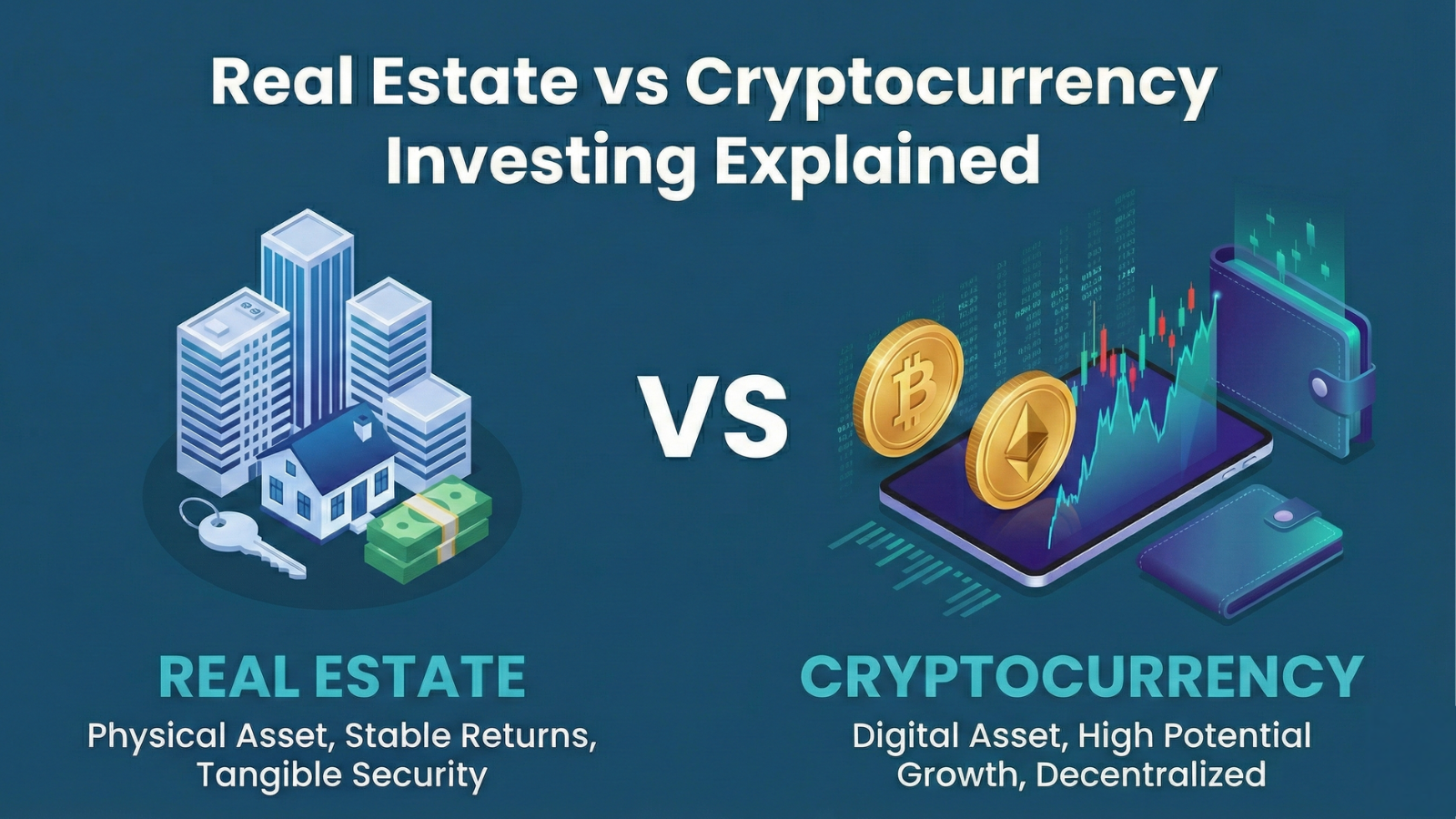
Real Estate vs Cryptocurrency Investing: Core Differences
The clearest way to understand real estate vs cryptocurrency investing is to look at how each asset behaves at a structural level. These differences influence everything from risk and returns to time commitment and emotional involvement.
Real estate investing involves acquiring exposure to physical property, either directly or through structured investment vehicles. Value is derived from the asset itself and the income it produces over time.
Cryptocurrency investing focuses on digital assets that exist entirely online. Prices are determined by supply, demand, market sentiment, and adoption rather than physical utility or income generation.
The table below outlines the core differences between real estate vs cryptocurrency investing.
| Feature | Real Estate Investing | Cryptocurrency Investing |
| Asset type | Physical, tangible property | Digital intangible assets |
| Value driver | Rental income and asset appreciation | Market sentiment and adoption |
| Volatility | Generally low to moderate | High and often unpredictable |
| Income generation | Rental yields and distributions | Limited or none for most assets |
| Price stability | Relatively stable over time | Frequent and sharp price swings |
| Time horizon | Long-term focused | Short- to long-term, often speculative |
| Asset backing | Real-world property | No physical backing |
| Emotional involvement | Lower | High due to rapid market movement |
This comparison highlights why real estate vs cryptocurrency investing appeals to very different investor mindsets, even though both sit outside traditional stock markets.
Risk, Volatility, and Price Stability
Risk is often the first concern when comparing real estate vs cryptocurrency investing, and for good reason.
Real estate risk tends to be structured and gradual. Property values can fluctuate due to interest rates, economic conditions, or local market dynamics, but changes usually occur over extended periods. This gives investors time to respond and adjust their strategy.
Cryptocurrency markets are far more volatile. Prices can rise or fall dramatically within hours, driven by news, market conditions, regulation, social sentiment, or large trades. While this volatility creates opportunities for rapid gains, it also exposes investors to sudden and significant losses.
Price stability is a major differentiator. Real estate values are supported by physical assets and income streams, which help to anchor pricing. Crypto prices, by contrast, are not tied to cash flow or tangible use in most cases.
When evaluating real estate vs cryptocurrency investing, investors should consider not only the potential upside but also how much volatility they are realistically prepared to tolerate.
Additionally, risk in the real estate vs cryptocurrency investing comparison is how each market responds to external shocks. Real estate markets tend to react slowly to economic changes such as interest rate adjustments or policy shifts. This slower response can provide investors with time to reassess and adapt their strategies rather than being forced into immediate decisions.
Cryptocurrency markets respond far more quickly. Prices can change within minutes of major announcements, regulatory news, or shifts in investor sentiment. While this responsiveness appeals to active traders, it can be challenging for investors who prefer stability and measured decision-making.
Price stability also affects investor behaviour. Real estate investors are less likely to make emotionally driven decisions because price movements are gradual and less visible day to day. Crypto investors, by contrast, are often exposed to constant price updates, which can encourage reactive decision-making.
When weighing real estate vs cryptocurrency investing, understanding how each asset behaves under pressure is as important as understanding potential returns.
Income Generation and Long-Term Value
Another major difference in real estate vs cryptocurrency investing is how value is generated over time.
Real estate offers two income components: ongoing rental income and long-term appreciation. Even during slower market periods, income can continue to flow as long as the property is occupied. This makes real estate attractive for investors seeking predictability and passive income.
Cryptocurrency does not typically generate income. Returns depend largely on price appreciation, meaning value is only realised when assets are sold. While some blockchain projects offer staking or yield mechanisms, these are not comparable to rental income and often carry additional risk.
Long-term value in real estate is supported by demand for housing and commercial space, population growth, and inflation protection. Crypto value depends on continued adoption, technological relevance, and market confidence.
From a planning perspective, real estate vs cryptocurrency investing presents a clear contrast between income-driven growth and speculative appreciation.
Another factor worth considering in the real estate vs cryptocurrency investing discussion is how each asset behaves during periods of economic uncertainty. Real estate income is often supported by long-term leases and ongoing demand for housing or commercial space, which can provide a level of resilience even when markets slow. While rental income is not guaranteed, it is typically less reactive to short-term market sentiment.
Cryptocurrency values, by contrast, tend to react immediately to economic news, interest rate changes, and shifts in investor confidence. This can amplify gains during bullish periods but also deepen losses during downturns. For investors relying on investments to support cash flow or long-term planning, this unpredictability can make crypto more difficult to manage as a core holding.
When assessing real estate vs cryptocurrency investing, the distinction between income-supported growth and sentiment-driven price movement becomes especially important for those prioritising financial stability over rapid gains.
Asset Backing vs Speculative Value
Perhaps the most fundamental distinction in real estate vs cryptocurrency investing is asset backing.
Real estate is backed by physical property that exists regardless of market sentiment. Even if prices decline, the asset remains usable and income-producing. This intrinsic utility gives property its defensive characteristics.
Cryptocurrency assets do not have physical backing. Their value is based on perceived usefulness, scarcity, and network adoption. If confidence declines, value can erode quickly.
This does not mean one is inherently better than the other. It means they serve different roles. Real estate tends to appeal to investors prioritising capital preservation and steady growth. Crypto attracts those willing to accept higher risk in exchange for potential outsized returns.
Understanding this distinction helps clarify why real estate vs cryptocurrency investing should not be viewed as interchangeable strategies.
Asset backing plays a critical role in how investors perceive value during market downturns. In real estate, the underlying asset continues to exist and serve a practical purpose regardless of price movements. Properties can still be leased, maintained, and improved, which helps preserve long-term value even during weaker market cycles.
Cryptocurrency lacks this physical anchor. When market confidence declines, there is no alternative use or income stream to support value. This can result in sharper drawdowns and longer recovery periods, particularly for assets without widespread adoption or utility.
Speculative value also influences investment time horizons. Real estate investors often enter with a long-term mindset, accepting short-term fluctuations in exchange for stability and income. Crypto investors may be more sensitive to short-term price action, which can increase turnover and amplify volatility.
This distinction helps clarify why real estate vs cryptocurrency investing appeals to very different psychological profiles. One prioritises endurance and income, while the other prioritises momentum and growth potential.
Real estate investing through Gamma Assets
Gamma Assets offers a modern approach to accessing real estate investing without the traditional barriers associated with property ownership.
Through Gamma Assets, investors can gain fractional exposure to income-generating real estate assets with clear asset backing, transparent income distribution, and structured compliance. This approach allows investors who might be familiar with digital platforms to participate in property markets without taking on speculative volatility.
For those comparing real estate vs cryptocurrency investing, Gamma Assets provides a bridge between digital accessibility and real-world asset stability, combining the benefits of property ownership with modern investment infrastructure.
You can start investing now from the Gamma Asset Investment Platform
Frequently Asked Questions
Is real estate less risky than crypto?
In general, yes. Real estate tends to be less volatile and more predictable than cryptocurrency. Property values usually change gradually, while crypto prices can move sharply in short periods. That said, all investments carry risk, and outcomes depend on market conditions and investor behaviour.
It is also worth noting that real estate risk can often be assessed in advance through factors such as location, tenant demand, and historical performance. Crypto risk is harder to measure upfront, as price movements are often driven by sentiment rather than fundamentals. This difference makes risk management more predictable in property investing.
Can tokenized property suit crypto investors?
Yes. Tokenized real estate can appeal to crypto investors who are comfortable with digital platforms but want exposure to asset-backed investments. It offers a way to stay within a familiar digital environment while reducing exposure to extreme volatility.
For crypto investors, tokenized property can feel like a natural extension rather than a shift in strategy. It allows participation in asset-backed investments without abandoning digital platforms, while introducing income and stability that purely speculative assets often lack.
Which offers more predictable returns?
Real estate typically offers more predictable returns due to rental income and long-term demand fundamentals. Cryptocurrency returns are less predictable and rely heavily on market sentiment and timing as they are linked to appreciation.
Predictability also affects financial planning. Real estate returns can often be modelled using expected rental income and expenses, whereas crypto outcomes are harder to forecast consistently. For investors prioritising planning and cash flow visibility, this difference is especially relevant.