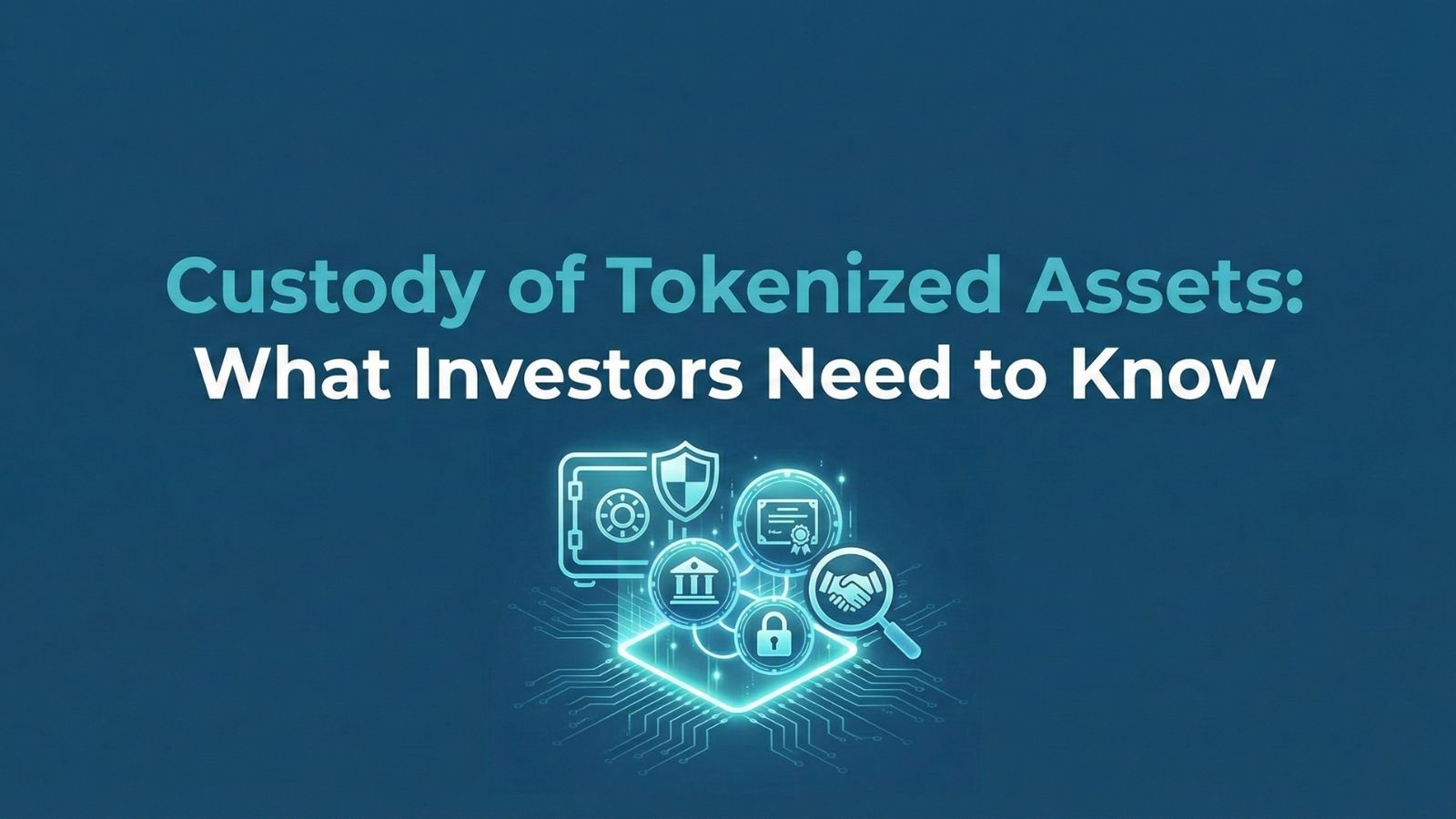
Custody of Tokenized Assets: What Investors Need to Know
As digital investing continues to mature, questions surrounding ownership, control, and protection have become just as important as questions about returns. Investors are no longer only asking what they own, but how that ownership is recorded, safeguarded, and enforced. This is where custody of tokenized assets becomes a central consideration.
Tokenization enables assets, such as property, commodities, or funds, to be represented digitally, typically using blockchain-based systems. While this improves accessibility and transparency, it also introduces new responsibilities around custody, security, and governance. Understanding how custody of tokenized assets works helps investors assess risk, accountability, and long-term confidence in digital investment platforms.
This article explains custody of tokenized assets in practical terms, explores how ownership records are stored securely, compares platform custody with investor self-custody, and outlines the custody standards used by professional platforms.
More topics can be read on the Gamma blog
Custody of Tokenized Assets Explained
Custody of tokenized assets refers to how digital ownership is held, recorded, and protected on behalf of investors. In traditional finance, custody is typically handled by regulated institutions such as banks or custodians that safeguard assets and maintain accurate ownership records. The same principle applies in tokenized investing, although the underlying systems differ.
Instead of paper certificates or centralised registries, tokenized assets rely on digital records. These records identify who owns which portion of an asset and define the rights attached to that ownership. Custody ensures that these records are accurate, tamper-resistant, and protected from unauthorised access or manipulation.
The importance of custody of tokenized assets lies in investor protection. Clear custody structures reduce the risk of ownership disputes, fraud, or loss. They also define who has authority over asset transfers, income distribution, and access controls.
Without proper custody arrangements, tokenization lacks credibility. Even well-structured assets can become risky if ownership records are unclear or insecure. For investors, understanding custody of tokenized assets is therefore a foundational requirement, not a technical afterthought.
Custody also plays a critical role in establishing trust between investors and platforms. When ownership is clearly recorded and independently verifiable, investors have greater confidence that their rights are recognised and protected. This becomes especially important in situations involving audits, disputes, or regulatory reviews, where clear custody records can determine how quickly and fairly issues are resolved.
In many ways, custody of tokenized assets mirrors traditional financial custody. Just as banks and brokers are responsible for safeguarding securities and maintaining accurate registers, digital platforms must demonstrate that they can provide the same level of accountability. Without this assurance, even well-designed tokenized assets can struggle to gain long-term investor confidence.
How Ownership Records are Stored Securely
Ownership records for tokenized assets are typically stored using secure digital ledgers, most commonly blockchain-based systems. These ledgers record transactions chronologically and immutably, meaning records cannot be altered without detection. Each issuance, transfer, or distribution is permanently logged.
This structure improves traceability. Investors and auditors can verify ownership history and confirm that circulating tokens match issued assets. Unlike traditional systems where records are maintained behind closed doors, digital custody systems allow continuous verification.
Security is multi-layered. Access to records is controlled through cryptographic keys, authentication protocols, and platform-level permissions. In regulated environments, additional protections such as audits, monitoring, and segregation of investor assets are used to reduce operational risk.
Legal alignment is equally important. Digital ownership records must correspond to enforceable legal rights off-chain. This ensures that token holders are not only visible in digital systems but also recognised as owners under applicable laws.
Effective custody of tokenized assets depends on both technical safeguards and legal clarity working together.
Over time, secure ownership records also support the full lifecycle of an investment. As income is distributed, ownership changes hands, or assets are redeemed, accurate records ensure that each action reflects the correct entitlements. This reduces administrative friction and helps prevent errors that could otherwise lead to disputes or delays.
For long-term investors, record integrity is particularly important. Immutable ownership histories provide reassurance that rights cannot be altered retroactively and that past transactions remain verifiable years later. This continuity strengthens the overall reliability of custody of tokenized assets and reinforces their credibility as a serious investment structure rather than a short-term digital experiment.
Platform Custody vs Investor Self-Custody
One of the most important distinctions in custody of tokenized assets is whether assets are held through platform custody or investor self-custody.
Platform custody means the platform manages storage, security, and authorised transfers on behalf of investors. This model prioritises ease of use, regulatory oversight, and reduced technical burden for investors. It is often preferred by those who value simplicity and protection.
Investor self-custody places control directly in the hands of the investor, typically through private digital wallets. While this offers greater autonomy, it also transfers full responsibility for security, key management, and transaction accuracy to the individual.
The table below outlines the key differences.
| Aspect | Platform Custody | Investory Self-Custody |
| Control | Platform-managed | Investor-managed |
| Security responsibility | Platform-led | Investor-led |
| Ease of use | High | Requires technical expertise |
| Regulatory oversight | Often regulated | Limited or none |
| Risk of user error | Lower | Higher |
| Recovery options | Defined processes | Often irreversible |
| Compliance handling | Built-in | Investor responsibility |
This comparison highlights the trade-offs involved in custody of tokenized assets. The right approach depends on investor experience, risk tolerance, and preference for control versus convenience.
Risks Related to Custody of Tokenized Assets
Custody introduces its own set of risks, regardless of structure. Understanding where these risks sit helps investors make informed decisions.
With platform custody, investors rely on the platform’s operational strength, governance, and security standards. Platform failure, cyber incidents, or mismanagement can temporarily affect access to assets. This is why transparency, segregation of assets, and regulatory oversight are critical.
Self-custody carries different risks. Losing private keys, falling victim to phishing attempts, or sending assets to incorrect addresses can result in permanent loss. Unlike traditional custody models, recovery options are often unavailable.
Legal risk is another consideration. If custody arrangements are poorly defined, disputes can arise over ownership, control, or asset recovery. Strong custody of tokenized assets requires alignment between digital records, contractual agreements, and legal recognition.
Custody risk is not about eliminating risk altogether, but about understanding responsibility, safeguards, and accountability at every stage.
It is also important to distinguish between asset risk and custody risk. Even high-quality assets can expose investors to loss if custody arrangements are weak or poorly designed. In such cases, failures in recordkeeping, access control, or governance can magnify losses that would otherwise be manageable.
This is why custody should always be assessed alongside regulatory standards, operational controls, and legal structure. Strong custody of tokenized assets does not remove risk, but it helps ensure that when challenges arise, ownership remains clear, recoverable, and enforceable. For investors, this clarity is often the difference between inconvenience and permanent loss.
Custody standards used by Gamma Assets
Gamma Assets applies structured custody standards designed to prioritise investor protection, transparency, and regulatory alignment.
Ownership records are maintained through secure digital systems that clearly define investor entitlements and link them to underlying assets. Custody arrangements ensure that digital ownership corresponds to real-world asset rights, reducing ambiguity.
Gamma Assets adopts a platform custody model to simplify the investor experience while maintaining robust security controls. This allows investors to participate without managing private keys or technical infrastructure themselves.
By combining digital recordkeeping with governance, compliance, and asset segregation, Gamma Assets addresses many common concerns associated with custody of tokenized assets, particularly around continuity and clarity.
Custody standards also play an important role in supporting long-term continuity. As tokenized investments mature, assets may be held for many years, transferred between investors, or inherited as part of estate planning. Clear custody frameworks help ensure that ownership can be verified and maintained across these changes without disruption. By prioritising defined custody responsibilities and robust recordkeeping, platforms can reduce uncertainty over time and provide investors with confidence that their ownership rights will remain intact regardless of changes in technology, personnel, or market conditions.
You can start investing now from the Gamma Asset Investment Platform
Custody of tokenized assets is a foundational element of digital investing. It determines how ownership is recorded, who controls assets, and how investors are protected when things go wrong.
As tokenization expands, custody is no longer a technical detail but a core consideration. Investors who understand custody of tokenized assets are better positioned to assess risk, select platforms responsibly, and participate in digital markets with confidence.
Frequently Asked Questions
Who controls tokenized assets?
Control depends on the custody model. Under platform custody, the platform manages access and transfers according to predefined rules and investor rights. Under self-custody, control rests entirely with the investor through their private keys.
Understanding who controls tokenized assets is a key part of evaluating custody of tokenized assets and determining where responsibility lies.
Can custody be transferred?
Yes, custody can often be transferred, subject to platform rules and legal structure. Transfers may occur between custodians, platforms, or approved wallets, provided compliance requirements are met.
Clear transfer processes support liquidity, succession planning, and investor flexibility within custody of tokenized assets frameworks.
What happens if a platform fails?
If a platform fails, outcomes depend on how custody is structured. Well-designed custody models segregate investor assets from platform operations, allowing ownership records to remain intact even if operations cease.
This is why custody of tokenized assets should always be evaluated alongside legal safeguards, asset segregation, and contingency planning.
Well-structured custody models are designed with this scenario in mind. By separating investor assets from platform operations and maintaining independent ownership records, custody frameworks can help ensure continuity even if a platform ceases operations. This makes custody design a critical consideration before investing, not after problems occur.