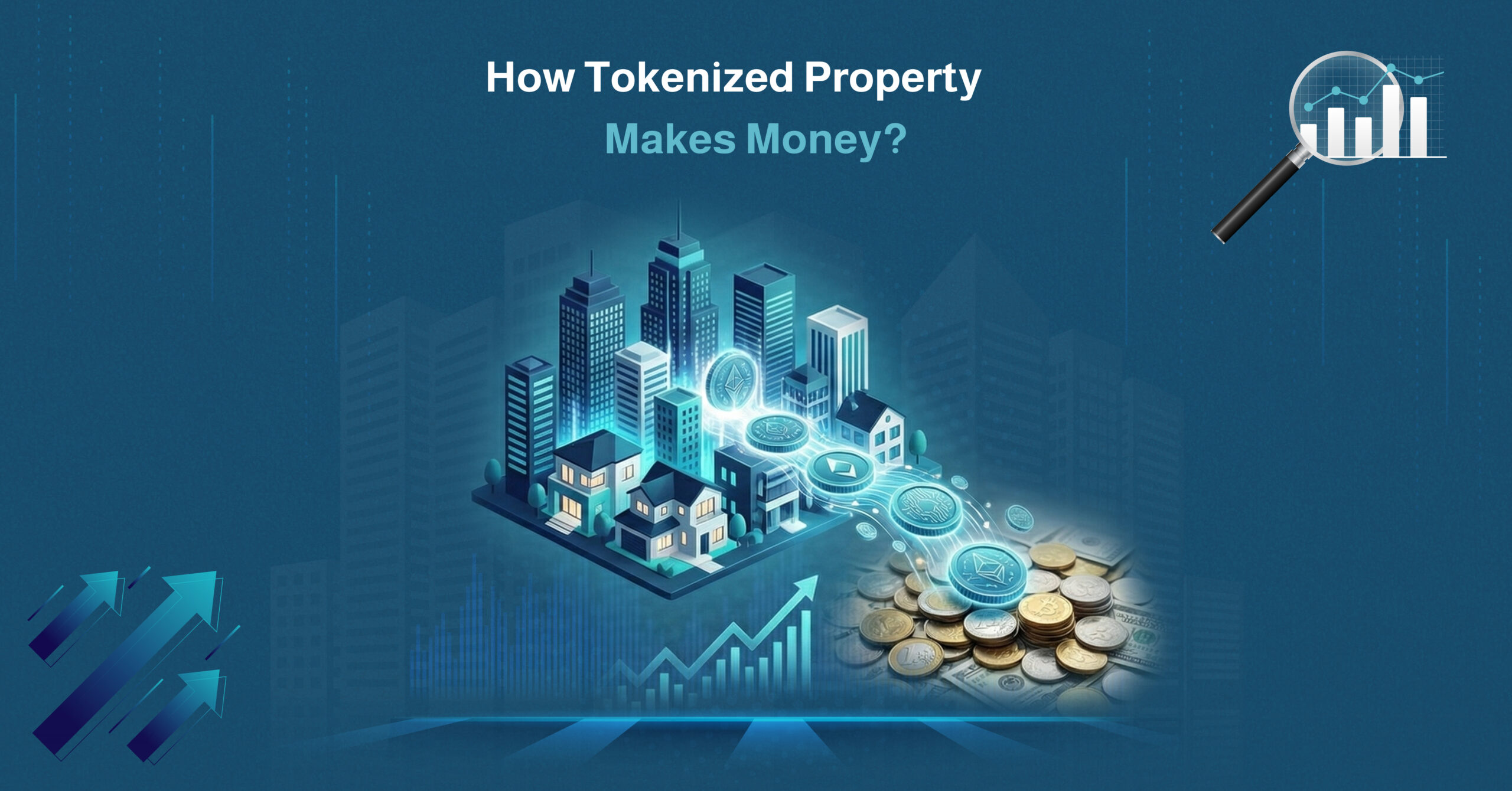
It is important to understand how tokenized property makes money before committing any capital to any digital real estate investment. Tokenization is a new technology that has its underlying revenue logic rooted in traditional property fundamentals. Rental income, asset appreciation, and operating costs still determine whetheran investment performs well over time.
Many investors still are under the misconception that tokenized property income is somehow detached from physical assets or driven by digital mechanics alone. In truth, tokens are a straightforward way of representing ownership and income rights tied directly to the performance of real-world property. If a property generates income, token holders benefit proportionally. If the property underperforms, returns are affected in the same way they would be for a traditional property owner.
We will explain how tokenized property makes money in this article. We will cover the sources of income, how cash flow and capital growth work in tokenized structures, the impact of costs on returns, and the risks investors need to consider. By the end, you should have a clear, realistic understanding of how revenue is generated and why property fundamentals still matter.
More topics can be read on the Gamma blog
How Tokenized Property Makes Money: The Core revenue model
In essence, how tokenized property makes money is virtually identical to how traditional real estate investing does, with the key difference being how ownership is structured and accessed.
Tokenized property divides the economic ownership of real estate into digital tokens. Each token represents a fractional share of the property’s financial performance. Holding tokens gives investors the right to a portion of the rental income and, in some cases, capital appreciation, depending on the structure of the offering.
Tokenization does not affect the basics; the tenant will still pay rent. Properties still rise or fall in value based on location, demand, and market conditions. What tokenization changes is accessibility. Instead of purchasing an entire property, investors can participate with smaller amounts of capital while still maintaining proportional exposure to income and growth.
With tokenized real estate, the revenue distribution is usually automated and transparent. Rental income is collected through a management team, operating costs are deducted, and net income is distributed to token holders based on their ownership share, or how many tokens they hold. This structure allows investors to clearly see how income is generated and allocated.
Understanding how tokenized property makes money begins with recognising that tokens are not speculative digital assets. They are financial representations of real property performance.
Rental Income and Operational Cash Flow in Tokenized Property
When evaluating how tokenized property makes money, rental income is often the primary source of ongoing returns. As with traditional property, income begins with tenants occupying the asset and paying rent.
Gross rental income refers to the total rent collected before expenses. However, investors do not receive gross income. Some operating costs need to be paid first, which include property management fees, maintenance, insurance, and periods of vacancy. The remaining revenue, after deductions, is the net distributable income.
In tokenized property structures, net rental income is distributed proportionally to the various token holders. For example, an investor holding 2% of the tokens would recieve 2% of the net rental income for that period. Distributions depend on the platform and asset structure, but may occur monthly, quarterly, or biannually.
Rental income is not fixed or guaranteed. Vacancies, late payments, unexpected repairs, or changes in rental demand can all impact cash flow. Understanding these fluctuations is essential to realistically assessing how tokenized property makes money over time.
This income stream rewards patience and stability. Properties in high-demand areas with reliable tenants, are the dream, and tend to produce a more predictable cash flow, while higher-risk assets may experience greater income variability.
Capital Growth and Asset Appreciation in Tokenized Property
When considering how tokenized property makes money, we have established that rental income is the main revenue stream, but capital appreciation plays a significant role, too. Capital appreciation occurs when a property increases in value over time. This may be due to market conditions, improvements, or increased demand.
Rental income is a steady and repeatable source of income, but capital growth is typically only realised at an exit event. This may involve selling the underlying property or, if permitted, trading tokens on a secondary market. Until that point, appreciation exists as an increase in asset value rather than cash income.
There are several factors that may affect capital growth, including location, economic conditions, interest rates, and long-term development trends. Just as with traditional property, appreciation is not guaranteed. If there is a downturn in the market, property values can plummet or be delayed.
Investors who do not have the time or inclination to manage or sell property would benefit from the tokenized structure, as they can participate in capital growth without hassles. There are some associated risks to be mindful of. Understanding how tokenized property makes money requires acknowledgingthat growth is dependent on real-world property performance, not digital mechanics.
Long-term investors often view capital appreciation as a complementary return, balancing shorter-term rental income with longer-term value creation.
Costs, Fees, and Variables that Affect How Tokenized Property Makes Money
A vital aspect to understand in how tokenized property makes money is recognising the difference between gross revenue and net returns. Costs and external variables play a major part in determining what investors actually receive. The table below outlines the primary cost categories and variables that affect returns in tokenized property investments.
| Cost or Variable | What it Covers | Impact on Net Returns |
| Platform fees | Fees for structuring, administration, reporting, and technology | Reduces income before distributions |
| Property management fees | Tenant management, rent collection, operational oversight | Ongoing reduction to rental cash flow |
| Maintenance and repairs | Routine upkeep and unexpected repair costs | Causes income while costs continue |
| Vacancy periods | Time when the property is unoccupied | Eliminates rental income while costs continue |
| Regulatory and compliance cost | Legal, reporting, and jurisdictional requirements | Fixed or variable deductions from revenue |
| Market conditions | Rental demand, interest rates, and economic cycles | Affects both income stability and asset value |
| Asset-specific risks | Location, tenant quality, and property age | Can increase costs or reduce income reliability |
These factors explain why returns vary over time. Well-performing properties are not impervious to short-term income dips from maintenance or vacancies. Strong rental demand can improve cash flow.
A clear understanding of costs is vital when evaluating how tokenized property makes money, as fees and variables directly influence net outcomes rather than headline figures.
How Gamma Assets Structures How Tokenized Property Makes Money
Platforms play an important role in shaping how tokenized property makes money, particularly when it comes to transparency, reporting, and revenue flow. Gamma Assets structures tokenized property investments by directly linking digital ownership to underlying real estate performance.
Each token represents a defined economic share of a specific property. Rental income, operating costs, and distributions are clearly reported, allowing investors to track performance without relying on assumptions. This structured approach helps investors understand exactly how income is generated and allocated.
Gamma Assets emphasises visibility into revenue flows rather than abstract performance metrics. Investors can see how rental income is collected, what expenses are deducted, and how net income is distributed. This helps investors make informed decisions while reinforcing the link between tokens and real estate.
Gamma Assets maintains a transparent structure, demonstrating how platforms can support investors’ understanding of how tokenized property makes money without overstating returns or minimizing risks.
You can start investing now from the Gamma Asset Investment Platform.
By focusing on property fundamentals rather than just looking at the digital terminology, investors can gain an understanding of how tokenized property makes money. Revenue comes from rental income and capital growth, while costs, fees, and market conditions determine the net returns.
Risk is not eliminated by tokenization, and it doesn’t guarantee income either. Instead, it offers a different method of accessing real estate, with fewer barriers through fractional ownership and transparent structures. Investors who understand both income drivers and expense variables are better equipped to make informed, long-term decisions.
How tokenized property makes money is determined by the same factors as traditional real estate. Asset quality, location, tenant demand, and cost management are at the center of sustainable returns.
FAQ
How does tokenized property make money if investors do not own the full property?
Tokenized property allows investors to own fractional economic shares rather than the entire asset. Each token represents a proportional claim on income and, where applicable, capital appreciation. If a property generates rental income, that income is divided among token holders according to their ownership percentage.
Does how tokenized property makes money depend more on rent or resale value?
It depends on investment structure and timeframe. Rental income provides ongoing cash flow, while resale value or capital appreciation contributes to longer-term returns. SOme investors prioritize income stability, while others focus on potential growth. Most tokenized property investments combine both elements.
Is how tokenized property makes money predictable or guaranteed?
No. Returns are influenced by tenant occupancy, operating costs, property condition, and market factors. While projections may be provided, income and capital growth can fluctuate. Understanding risk is a critical part of evaluating how tokenized property makes more realistically.
How often do tokenized property investors receive income distributions?
Distribution frequency varies by platform and asset. Some properties distribute income monthly, while others do so quarterly. Timing depends on rental collection cycles, expense settlements, and reporting processes.
Can costs increase overtime in tokenized property investments?
Yes. Maintenance expenses, regulatory requirements, and management costs can change over time. These increases can affect net returns, reinforcing the importance of understanding cost structures when evaluating how tokenized property makes money.