Real estate has long attracted investors looking for stable assets, income potential, and long-term value growth. Over time, different investment structures have emerged that allow investors to access property markets without directly purchasing and managing physical real estate. Among the most widely discussed approaches today are private equity real estate funds and tokenized real estate investments, we will take a look at Real Estate Tokenization vs Private Equity Property.
Private equity real estate has existed for decades and is commonly used by institutional investors and high-net-worth individuals. These funds typically pool capital from investors and deploy it into large-scale property projects such as commercial buildings, residential developments, or infrastructure-related real estate assets. While this model has traditionally been associated with professional investment firms, it has also attracted private investors seeking exposure to large property portfolios.
More recently, digital financial infrastructure has introduced another investment model: tokenized real estate. Through digital investment structures, property assets can be represented through fractional investment units that allow investors to participate economically in a property-backed opportunity.
As these models continue to develop, investors are increasingly comparing real estate tokenization vs private equity property to understand how each investment structure operates. Evaluating the differences between real estate tokenization vs private equity property can help investors assess factors such as ownership structure, capital requirements, investment accessibility, and liquidity before deciding which model aligns with their investment goals.
More topics can be read on the Gamma blog
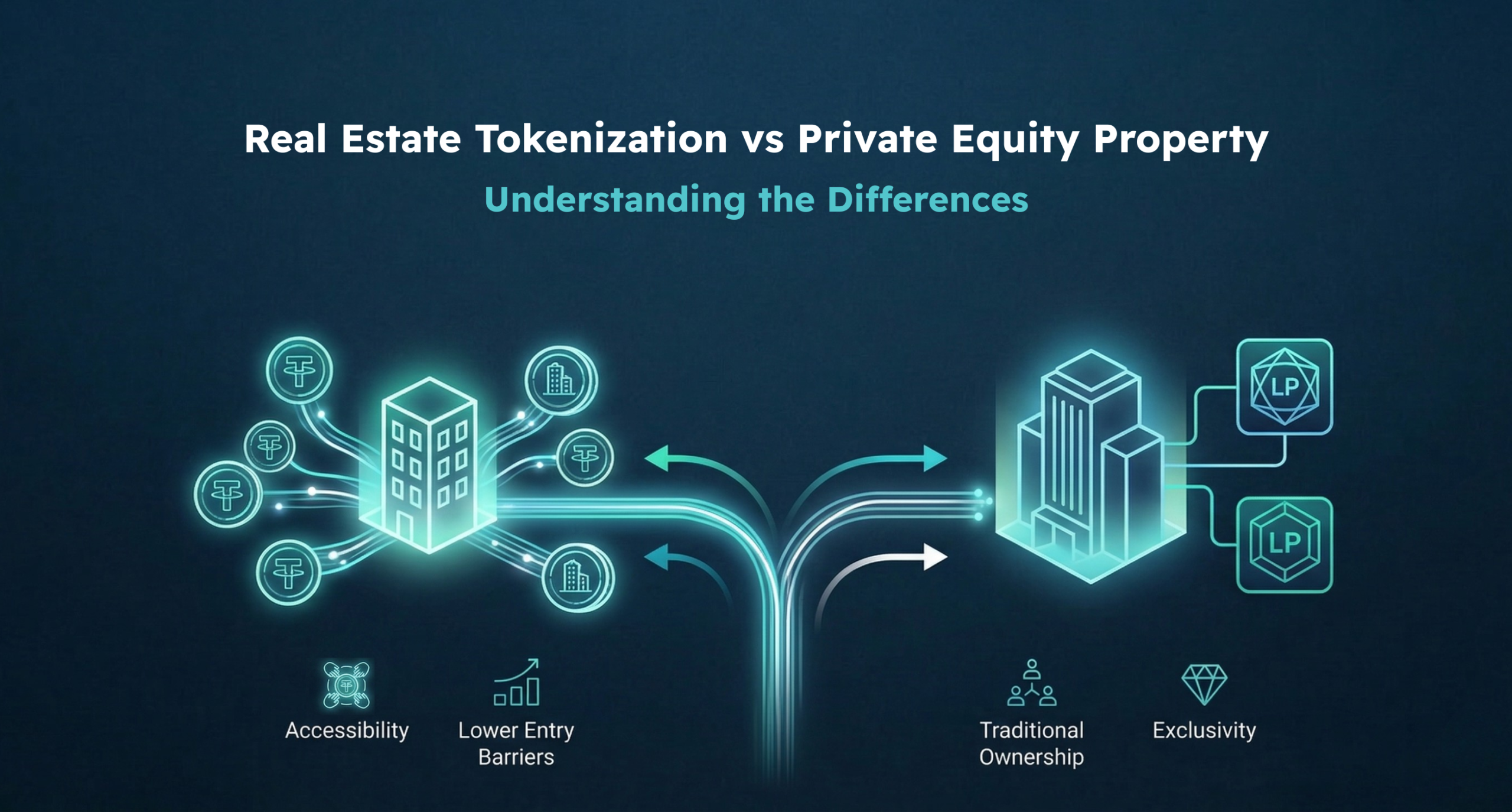
Understanding Real Estate Tokenization vs Private Equity Property
The comparison between real estate tokenization vs private equity property begins with understanding how each investment model is structured. Both approaches allow investors to gain exposure to real estate assets without directly owning property, but they operate through different frameworks.
Private equity real estate funds typically collect capital from investors and deploy it into a portfolio of properties managed by professional fund managers. Investors commit capital to the fund, and the management team is responsible for acquiring, operating, and eventually exiting the property investments.
Tokenized real estate operates through a different structure. Instead of committing capital to a traditional investment fund, investors participate in real estate-backed opportunities through digital investment units linked to an underlying asset. These units represent economic participation in a property or real estate investment structure.
When comparing real estate tokenization vs private equity property, accessibility becomes an important factor. Private equity funds often require large minimum investments and may be available only to accredited or institutional investors. Tokenized real estate platforms, depending on how they are structured, may allow smaller participation sizes.
While both models aim to provide exposure to property-backed assets, the operational frameworks behind real estate tokenization vs private equity property reflect different approaches to investor participation and market accessibility.
Investment Structures and Ownership Models
One of the most significant distinctions between real estate tokenization vs private equity property lies in how investment ownership is structured. Private equity real estate funds typically operate through pooled investment vehicles where investors contribute capital to a managed fund.
In this structure, the fund manager makes strategic decisions regarding property acquisitions, asset management, and eventual sales. Investors hold units in the fund rather than ownership of individual properties. Returns are generated through rental income, asset appreciation, or the sale of properties within the portfolio.
Tokenized real estate investments generally operate through a more segmented structure. Instead of pooling capital into a single fund, individual properties or projects may be represented by digital investment units tied to a specific real estate asset.
This difference means that when comparing real estate tokenization vs private equity property, investors may experience varying levels of transparency regarding the underlying assets. Tokenized models often provide more direct visibility into the specific property associated with an investment.
Private equity real estate funds, on the other hand, typically focus on diversified portfolios managed by experienced investment teams. Understanding these differences in ownership structure helps investors evaluate the relative advantages of real estate tokenization vs private equity property investment models.
Capital Requirements and Investor Access
Capital requirements represent another key difference when evaluating real estate tokenization vs private equity property. Private equity real estate funds frequently require substantial minimum investment commitments. These minimums can range from tens of thousands to millions of dollars, depending on the scale and structure of the fund.
Because of these requirements, private equity real estate has historically been more accessible to institutional investors, family offices, and high-net-worth individuals. While these funds may provide professional asset management and large-scale investment opportunities, they can be difficult for smaller investors to access.
Tokenized real estate models attempt to address this barrier by dividing property investments into smaller digital units. This fractional structure allows investors to participate in property-backed investments with smaller capital commitments.
For investors comparing real estate tokenization vs private equity property, this accessibility difference can significantly influence investment decisions. Tokenization introduces the possibility of broader participation in real estate markets, particularly for investors who may not meet the capital thresholds required by private equity funds.
However, regardless of the investment model, investors should still evaluate asset quality, governance structures, and financial projections carefully before committing capital.
Another factor investors often evaluate when comparing real estate tokenization vs private equity property is how quickly they can begin building exposure to multiple property investments. In traditional private equity funds, investors typically commit a fixed amount of capital that is deployed gradually by the fund manager as new opportunities are identified. This structure can make it difficult for investors to control exactly how their capital is allocated across specific assets. Tokenized real estate models may provide more flexibility in this area because investors can review individual opportunities and decide how to distribute capital across different property assets. For investors comparing real estate tokenization vs private equity property, this level of allocation control can be an important consideration when building diversified real estate portfolios.
Liquidity and Time Horizons
Liquidity is another factor that investors often consider when comparing real estate tokenization vs private equity property. Real estate investments typically involve longer time horizons because property assets require time to generate value through rental income and appreciation.
Private equity real estate funds usually operate with defined investment cycles. Investors commit capital for a fixed period, which may range from five to ten years or more. During this time, fund managers focus on acquiring, improving, and eventually exiting property investments.
Tokenized real estate investments may introduce different possibilities for liquidity depending on how digital trading infrastructure develops. Some tokenized models aim to support secondary trading environments where investors may transfer or sell their investment units to other participants.
While these markets are still evolving, the concept of liquidity has become a central topic when evaluating real estate tokenization vs private equity property. Tokenized investment models may offer additional flexibility compared with traditional private equity structures.
Despite these differences, both models should generally be viewed as long-term investment strategies. Understanding the expected time horizon associated with real estate tokenization vs private equity property helps investors align investment choices with their financial goals.
How Osool Gamma Simplifies Property Investment Opportunities
Digital investment platforms are increasingly playing a role in modernizing how investors access property markets. Platforms such as Osool Gamma illustrate how digital infrastructure can simplify participation in real estate-backed investment opportunities.
For investors comparing real estate tokenization vs private equity property, Osool Gamma provides a simplified path to property-backed investment opportunities.
Instead of navigating complex fund structures or direct property acquisition processes, investors can access real estate-backed opportunities through a structured digital platform. This approach helps reduce some of the operational barriers traditionally associated with property investing.
By presenting clearly structured investment opportunities linked to real estate assets, platforms like Osool Gamma allow investors to review opportunities and allocate capital more efficiently.
As digital real estate investment ecosystems continue to evolve, platforms such as Osool Gamma demonstrate how technology can expand access to property-backed investments while maintaining the core fundamentals of real estate investing.
You can start investing now from the Osool Gamma Investment Platform
Real estate continues to play an important role in diversified investment portfolios, offering long-term value and income potential. As investment structures evolve, investors now have multiple pathways to access property-backed opportunities.
The comparison of real estate tokenization vs private equity property highlights how these investment models differ in structure, accessibility, and operational frameworks. Private equity real estate funds provide professionally managed property portfolios but often require substantial capital commitments and longer investment horizons.
Tokenized real estate introduces a different approach by allowing investors to participate through digital investment units linked to specific property-backed opportunities. This model may expand accessibility and provide additional flexibility depending on how digital trading platforms develop.
Understanding the distinctions between real estate tokenization vs private equity property helps investors evaluate which approach best aligns with their financial resources, investment objectives, and preferred level of involvement in property markets.
FAQ
What is private equity real estate investing?
Private equity real estate involves pooled investment funds where investors contribute capital that is used to acquire and manage property assets. Professional fund managers oversee investment decisions and portfolio management.
How does tokenized real estate differ from private equity property funds?
When comparing real estate tokenization vs private equity property, the main difference lies in the investment structure. Private equity funds pool capital into large property portfolios, while tokenized models allow investors to participate in property-backed investments through digital units linked to specific assets.
Is tokenized real estate more accessible than private equity funds?
Tokenized real estate may allow smaller investment amounts through fractional ownership structures. Private equity funds often require higher minimum investment commitments.
Are both models long-term investments?
Yes. Both private equity real estate funds and tokenized property investments are generally considered long-term strategies because property assets typically require time to generate income and appreciation.
References
World Economic Forum – Tokenization of Real Assets
Deloitte – Digital Asset Investment Reports
PwC – Global Blockchain and Digital Asset Insights
Investopedia – Private Equity Real Estate Explained